



Applying for the start-up grant – moving from the employment office to self-employment
Original article: 2023-05-05. English translation. Programme details reflect the original publication date.
What is a start-up grant (Gründungszuschuss)?
Anyone who becomes unemployed and cannot find a reasonably suitable position can apply for government funding to start a self-employed business. The grant is intended to make it easier for unemployed individuals to take the step into self-employment. However, the grant is subject to certain conditions. Only those who know these requirements and take the right steps at the right time can fully benefit from this funding instrument and apply for the start-up grant. Deadlines for submitting the application are particularly important.
What does “grant” mean?
A grant means you receive the money as a gift. You do not have to repay the money – the start-up grant – at any point.
What is the purpose of the start-up grant?
The start-up grant is intended to help you cover your living expenses and ensure social security (e.g. health insurance, etc.) during the initial phase of your self-employment. Purchases and investments may not be financed from this grant.
From the perspective of the Federal Employment Agency, the aim is that you permanently end your unemployment through your self-employment.
For this reason, the Federal Employment Agency places great importance on:
- The an expert opinion on the viability of your business start-up
and - The its own review by the Federal Employment Agency.
What is important when applying for the start-up grant?
You may become permanently independent of unemployment benefits through your self-employment. Is the payment of the start-up grant necessary for this?
You must demonstrate to the Federal Employment Agency that the start-up grant is necessary to secure your livelihood and social security (according to § 93 SGB III).
The necessity of the start-up grant on the one hand and the proof of viability of your self-employment on the other hand, should be made clear in the business plan you submit.
For your start-up grant to be approved, the caseworker at the Federal Employment Agency requires a so-called viability certificate. This certificate serves as proof that your business start-up is viable, meaning you are expected to be able to cover your living expenses and social security (health insurance, etc.) independently through your business, without continuing to claim unemployment benefits.
The viability certificate is sent by an expert body to the Federal Employment Agency. The expert body has the necessary expertise to assess whether your self-employment can generate profit, ensuring your living expenses and social security are covered.
Starting a business from unemployment
Unemployed individuals who wish to apply for a start-up grant must have paid into the statutory unemployment insurance for at least 12 months, i.e. have held a job subject to social insurance contributions for at least one year. Appropriate proof must be provided. Only then are unemployed persons entitled to ALG I. Before applying for the start-up grant, there must be at least five months, or approximately 150 days, of entitlement to ALG I remaining. Unemployed individuals planning to start a business should use this time to prepare for their future activity, but must still be available to the primary labour market during this period.
Government funding for business start-ups
If deadlines and requirements are consistently observed when starting a business from unemployment, the unemployed founder can extend the duration of ALG I beyond the regular twelve-month period by a further six months. During this time, the founder receives their ALG I at the previous rate for an additional six months. This is funding under SGB III. It is intended to help future self-employed individuals through the challenging first months after starting up and to facilitate the transition into self-employment. This allows the founder to cover their living expenses without having to use savings. In addition to ALG I, the founder receives an extra €300 per month for social security contributions for six months.
After the initial six months of funding, there is a further opportunity to apply for funding. The founder can receive €300 per month for social security for an additional nine months. Health insurance contributions are thus secured for a further nine months. Unlike the six-month extension of unemployment benefit I, these additional nine months are not financed from statutory social insurance contributions, but from tax funds. The legal basis for this is § 93 SGB III. Proof must also be provided for this second application. The founder must present the economic situation in concrete figures and provide a forecast for the next six months, i.e. how the business is likely to develop.
Nothing works without a business concept
Applicants should definitely develop a basic business concept for their future self-employment. This does not yet need to be a detailed business plan. However, it should show that the founder will be able to support themselves from the business no later than 36 months after starting up. The first six months, or the seventh month, are particularly important. Here, the applicant must demonstrate that the business is sustainable and that the founder can support themselves from it. Surpluses must be shown in the financial projections. This is the entrepreneur’s salary, which must enable the founder to make a living. In addition to the financial figures in the business concept, the founder must provide a written description of their project. This should be between 20 and 30 pages. The third part then consists of the annexes. These include, in addition to the CV and business and tax registration, certificates of participation in a start-up seminar and similar documents.
For the business concept, the founder definitely needs an expert opinion from a third party. This is essentially the business plan for the start-up grant. Depending on the scope and level of detail, you should budget between €50 and €150 for the opinion. The assessment can be carried out by the Chamber of Commerce (IHK), a tax advisor, or a business consultant. X-Group GmbH Institute for Start-up, Financing and Business Development in Berlin has extensive experience in this area and has already provided opinions for hundreds of business concepts, over 90 percent of which have been approved.
Applying for the start-up grant: These documents are required for the expert opinion
To carry out the necessary assessment, the expert body requires various information and documents from you:
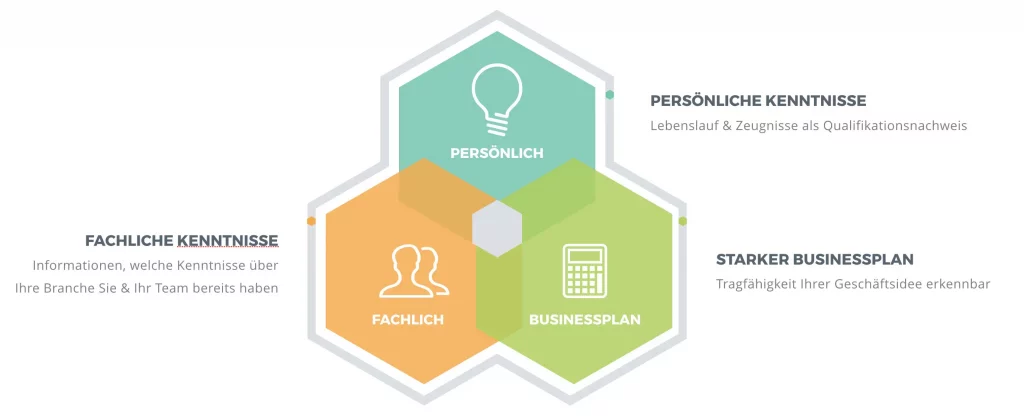
- Your CV and certificates, to demonstrate the professional and commercial skills you have already acquired
- Information on the knowledge you already have about your sector
- Your business plan, in which you explain various aspects about yourself and your self-employment in more detail, including:
- Your product or service and its unique selling point
- Who you expect your customers to be
- Which marketing measures you are planning
- What turnover you expect
- How much profit you are likely to generate
- How you intend to finance your business
- What prospects of success you see
The viability of your business start-up will be evident primarily from the business plan.
What deadlines must the founder observe when applying for the start-up grant?
In order for the process to be successful, founders must observe certain deadlines. Only after the unemployed person has received their ALG I (German unemployment benefit) notification should they take action in this direction—not before. Recipients of ALG I under SGB III must, in principle, be available to the labour market. Daniel Schäfer, Managing Director of X-Group GmbH in Berlin, expressly points this out. The caseworker at the Employment Agency is required to continuously provide the unemployed person with job offers. In the first 1–3 months after receiving the notification, the unemployed person must cooperate with the employment advisor and provide evidence of job applications and rejections before they can apply for the start-up grant (Gründungszuschuss). Only after this initial period can the employment advisor issue the forms required to apply for funding for the business start-up. It should also be noted that, at the time of application, the applicant must still have at least 5 months of ALG I entitlement remaining. If this deadline has passed, it is at the discretion of the advisor whether the application will still be accepted. In the worst case, the unemployed person may be completely denied the opportunity to apply. In such a case, there is no further possibility to receive a start-up grant, and if no job is found during the benefit period, the individual will move from ALG I to ALG II (Hartz IV) once ALG I expires.
Applying for the start-up grant—simply explained and made easy!
What can you do to increase the chances of a favourable decision, i.e., to receive the start-up grant?
- You present your personal and professional knowledge and skills
- You submit a convincing business plan
Applying for the start-up grant when a business already exists
If the unemployed person has already registered a business as a sideline and is generating revenue, this is not, in principle, an obstacle to applying for the start-up grant. However, certain rules must be strictly observed if you wish to receive government funding for your start-up. The basic rule is: as a sideline, the unemployed person may work a maximum of 15 hours per week, and the profit generated may not exceed 165 euros per week.
The background is as follows: The Employment Agency assumes that even if the founder is generating revenue from a sideline, they are still available to the primary labour market and can be placed in employment. Of course, they may generate much higher revenue than 165 euros. For example, they could generate 1,000 euros in income if they have 835 euros in expenses, such as for a laptop or a website. Under no circumstances may the average weekly additional earnings exceed the 165-euro limit. Otherwise, any amount exceeding 165 euros will be offset against ALG I, resulting in a reduction of unemployment benefit. There are, however, exceptions. If the applicant has earned income from a sideline for the past twelve months or longer and the average weekly earnings are higher, the limit will be adjusted accordingly.
Once the application for the start-up grant has been approved, the founder can theoretically generate up to one million euros per month in revenue. This has no impact on the approved payment of funding. The amount granted in the approval notice cannot be reduced and will be paid in full as approved.
Why working with a business consultant is worthwhile
Want to apply for the start-up grant and be on the safe side? Then it is advisable to work with a business consultant, even if the consultant costs a few hundred euros. Daniel Schäfer, specialist advisor for funding and business start-ups, points out that this concerns amounts of up to 15,000 euros in grants plus 2,700 euros for social insurance. It would be a shame if these funds were not approved because the founder made formal errors in the application, leading to rejection. However, even if all else fails and the founder—for whatever reason—does not receive funding or the business is not deemed viable by the seventh month, there is still the possibility to receive subsistence or investment grants during the start-up phase. These forms of support are then provided under SGB II and fall under the responsibility of the Job Centre.
Key facts about the start-up grant
Below you will find the most important conditions for approval of the start-up grant:
- The Federal Employment Agency is not obliged to pay you the start-up grant. Instead, it is a discretionary decision, meaning your responsible caseworker
at the Federal Employment Agency will write a justification as to why you are being granted the start-up grant or why you are not. Your caseworker will therefore need arguments to support the approval of your start-up grant. - A direct transition from employment to self-employment supported by the start-up grant is not possible
- Priority is given to placing you in employment before paying the start-up grant. Therefore, it will first be checked whether you can be placed in dependent employment. Only after this assessment can a start-up grant be considered.
- You must apply for the start-up grant before commencing your full-time self-employment, which must involve at least 15 hours per week.
If you are still engaged in another activity, this must involve fewer hours per week than your self-employment, so that your self-employment is considered your main occupation.
You can only receive the grant if you were registered as unemployed and receiving ALG I before starting your self-employment. - You need to provide a date on which you will commence your full-time self-employment. If you are already self-employed full-time, please state since when.
- If you are currently self-employed on a part-time basis, you must convert this into your main occupation.
- The commencement of your self-employment must be proven to the Federal Employment Agency.
This is done either by providing proof of business registration (for commercial professions) or with the tax office (for freelance activities), and for skilled trades: confirmation of registration with the Chamber of Crafts.
If you have already carried out your self-employment on a part-time basis, you must provide proof to the business registration office, tax office, or Chamber of Crafts that you have switched from part-time to full-time self-employment. - If you have previously been self-employed and have since ceased your self-employment, you may still be eligible for a start-up grant.
You must explain to the Federal Employment Agency why you gave up your previous self-employment. - Naturally, you need to have the necessary expertise and suitable skills to carry out your self-employment. These skills and qualifications must be explained to the Federal Employment Agency and, if necessary, evidenced. If there are doubts as to whether you possess the required knowledge and skills, it is possible
that the Federal Employment Agency will require you to attend seminars.
By attending the seminar(s), you can then demonstrate that you have acquired the necessary knowledge and skills, at the latest by completing the seminar(s).
This would remove any doubts and bring you closer to approval of the start-up grant, and thus to your goal. - At the time you commence self-employment (=date), your entitlement to unemployment benefit (ALG I) is less than 150 days, or your entitlement to ALG I is based solely on § 147 (3) of the Third Book of the Social Code (SGB III), the so-called ‘short qualifying period.’
Where can you obtain the application for the start-up grant?
Would you like to apply for the start-up grant and are looking for the application form? You will receive your personalised application, including all documents, from the Federal Employment Agency. The application will already include your data stored with the Employment Agency, such as your address, reference number, etc.
What is the amount and duration of the start-up grant?
The start-up grant is paid in up to two phases, which means for you:
Phase 1:
You will initially receive the start-up grant for 6 months. During this period, the amount of the start-up grant funding is:
- The amount of your most recently received unemployment benefit (ALG I) plus a flat rate of €300.
- This flat rate of €300 is primarily intended for your social security (health insurance, etc.).
- Would you like to receive the start-up grant beyond these 6 months (Phase 1)?
Then you must submit an application to the Federal Employment Agency.
Phase 2:
You have submitted your application to continue receiving the start-up grant. For the period after the first 6 months, you may be eligible to receive the start-up grant for a further 9 months at the flat rate of €300.
The following also applies:
- There is no obligation for the Federal Employment Agency to approve this start-up grant.
- For continued payment of the start-up grant, the Employment Agency will ask you
a) about your business activities in the previous months
and
b) about your plans for the future of your business
You can demonstrate that you have been actively engaged in your full-time self-employment, for example, by presenting your income and expenses.
Further information on the start-up grant:
Impact on the duration of unemployment benefit (ALG I):
If a start-up grant is paid in the amount of the most recently received unemployment benefit, this affects the duration of entitlement to unemployment benefit (ALG I). For further information, please arrange a free initial consultation at the X-Group Institute in Berlin.
Option of unemployment insurance, upon application:
Self-employed individuals have the option to take out unemployment insurance upon application. If you wish to apply, you can obtain further information at a free initial consultation at the X-Group Institute in Berlin.
Start of pension and consequences for the start-up grant:
If you reach retirement age while receiving the start-up grant (Gründungszuschuss), payment of the grant will be discontinued. The grant will still be paid for the month in which your birthday falls, but not for the following month.
When are you excluded from receiving the start-up grant (Gründungszuschuss)?
- If you are receiving Unemployment Benefit II (“Hartz4”), you may be eligible for Einstiegsgeld (start-up allowance). For further information, please contact your local Jobcentre or arrange an appointment to discuss ‘Einstiegsgeld’. a free initial consultation at the X-Group Institute.
- Have you received any funding in the last 24 months:
Have you received bridging allowance, start-up grant for self-employment, or a start-up grant (Gründungszuschuss) to start a self-employed activity?
If yes, you can only apply for the start-up grant (Gründungszuschuss) once at least 24 months have passed since the end of your last funding.
Can the start-up grant (Gründungszuschuss) be combined with Einstiegsgeld and LES?
If you are receiving Unemployment Benefit II (“Hartz4”) because your ALG I (German unemployment benefit) rate is too low and can therefore be topped up with ALG II, you can also apply for Einstiegsgeld and LES.
You can find out how this works and how to apply for both in parallel during a free initial consultation with us.
Can you receive other funding or support for your business in addition to the start-up grant (Gründungszuschuss)?
You can find out whether and which funding or support you may still be eligible for in a free initial consultation with experienced entrepreneurs and competent advisors. We are happy to assist you with your start-up grant application.
Your next step? – Take action!
Secure your voucher now and book a free strategy session with one of our start-up experts:

